How to Make Money With AI: 7 Honest Ways to Start
AI isn't the money, you are, but it can make your work a whole lot faster.

You make money with AI by using it to do work people already pay for, like writing, content, digital products and services, faster than you could alone. Platforms set their own rules: YouTube needs 1,000 subscribers plus 4,000 watch hours or 10 million Shorts views to share ad revenue, and won't monetize mass-produced AI template content.
What's in this guide
- Can you actually make money with AI?
- What are the best ways to make money with AI?
- Can you sell things that AI helps you make?
- How do you make money with AI on YouTube and social media?
- How do you spot a make money with AI scam?
- Do you have to pay taxes on money you make with AI?
- Start where you already have something to offer
Okay so if you've been searching how to make money with ai, you've probably seen a lot of big promises and very few straight answers. The truth is messier and honestly more useful than the hype. AI doesn't pay you. People pay you. AI just helps you do the work faster, whether that's writing, making content, building digital products, or running a service for small businesses.
You make money with AI by using it to do work people already pay for, faster. That's it. That's the whole thing. Everything below is just the specifics.
Can you actually make money with AI?
Yes, and a lot of people are already doing it, just not the way the ads make it look.
According to Pew Research Center, 34% of U.S. adults have used ChatGPT, and 28% of employed adults now use it for work. That number jumped 20 percentage points in just two years.
But here's what those stats don't say: using AI for work and getting paid well for work are two different things. The people making it work are using AI to help with real skills, writing, editing, making content, building products, teaching what they know. Me? I draft scripts during nap time and always edit before anything goes live. The AI gets me most of the way there. The rest is still me.
If you're just starting out, the make money with ai online path is very doable, but it starts with picking something people actually want to pay for.
What are the best ways to make money with AI?
There are seven solid ways to do this, and most of them can start small, from scratch.
- Freelance writing or editing with AI as your first-draft helper. You write, AI drafts, you fix it and make it good. Platforms like Upwork charge a service fee that ranges from 0% to 15% per contract, and you see the exact fee before you accept any offer.
- Social media help for small businesses. Captions, content calendars, post ideas. So many local businesses have no idea what to post. If you can show up consistently with ideas and copy, that's a real service worth paying for.
- Faceless or face content on YouTube and social. This one gets its own section below because there are specific rules to know before you start.
- Ebooks and low-content books on Amazon KDP. Amazon offers 35% and 70% royalty options for eBooks. AI can help you outline and draft, but KDP has disclosure rules covered in section three.
- Digital products like templates, planners and prompt packs. These take time to build once and can sell repeatedly. AI speeds up the building part significantly.
- UGC or affiliate content. If a brand pays you or sends you something to talk about, the FTC requires you to disclose that relationship. That rule applies whether you use AI or not. More on being a UGC creator if that path interests you.
- Teaching a skill you already have, with AI helping you make the material. Outlines, slide decks, workbooks, email sequences. If you know something, AI can help you package it faster.
Can you sell things that AI helps you make?
Mostly yes, but there are important details that change depending on what you're selling and where.
On the ownership question: OpenAI's terms say you own the output from their tools. But they also say the output may not be unique, meaning someone else could get something very similar. And they're clear that you need to evaluate output for accuracy before you use or share it. You also can't represent AI-generated output as human-generated.
The copyright side is a little more complicated. The U.S. Copyright Office says prompts alone aren't enough to get copyright protection on AI output. But if you make real creative changes or additions, those human contributions can be protected. Using AI to assist your creative process doesn't automatically block you from copyright either.
For Amazon KDP specifically: KDP requires you to disclose when content is AI-generated, meaning the AI wrote it. If you wrote it yourself and used AI to edit, refine or improve it, that counts as AI-assisted, and you don't have to disclose that. You're still responsible for making sure everything follows their content guidelines.
None of this is legal advice. If you're building something significant, a conversation with an actual lawyer is worth it.
Want the good stuff early?
Join the early bird list for my AI video editing course. First access, lowest price ever, plus social media tips by email. Unsubscribe anytime.
Free. Unsubscribe whenever you want. Privacy
How do you make money with AI on YouTube and social media?
You can, but YouTube specifically has rules that matter a lot if you want to get paid through their platform.
To join the YouTube Partner Program and get ad revenue, you need either 1,000 subscribers with 4,000 qualified watch hours in the last 12 months, or 1,000 subscribers with 10 million qualified Shorts views in the last 90 days.
Once you're in, your content still has to qualify. YouTube's monetization policies are clear that content must not be mass-produced, generic, or repetitive. They specifically call out AI-generated content made with generic or unoriginal templates that give the impression of mass production without adding the creator's original, authentic insights or perspective. As of July 15, 2025, YouTube renamed this policy from "repetitious content" to "inauthentic content." Your perspective is the part YouTube actually wants to see.
On social media more broadly, if a brand pays you or gives you anything of value to mention a product, the FTC says you have to disclose that. That's your responsibility as the creator, AI in the mix or not.
How do you spot a make money with AI scam?
If someone is promising you big monthly earnings with little effort and asking for money upfront, that's the pattern the FTC has already sued people over.
The FTC announced a crackdown on deceptive AI claims in September 2024. The cases involved schemes that falsely claimed AI-powered tools would help consumers quickly earn thousands of dollars a month. The FTC chair said directly: there's no AI exemption from the laws on the books.
The FTC's guidance on coaching and business opportunity scams gives you a short checklist of things to ask before paying anyone:
- What would I actually be selling or doing? If they can't answer this clearly, stop.
- How does the business generate income? Vague answers here are a red flag.
- What are my specific expenses? You need real numbers, not "it depends."
- When would I expect to turn a profit? If they dodge this, that tells you something.
The FTC also flags this one specifically: if the promoter keeps asking you to pay more money to make your business succeed, stop. And never hand over credit card or bank information before you have real answers to those questions.
The laziest-sounding offers are almost always the ones worth being most skeptical about.
Do you have to pay taxes on money you make with AI?
Yes, and this applies even if it's part-time, even if it's small, and even if nobody sent you a form.
The IRS is clear that income from gig and side work has to be reported on your tax return, even if it's from part-time or temporary work, even if no information return was sent to you, and even if you were paid in cash, goods, or other non-standard ways.
That covers freelance writing, digital product sales, affiliate income, YouTube revenue, all of it.
This isn't tax advice, and the specifics of what you owe depend on your situation. A tax professional or CPA who works with self-employed people is worth finding before the income gets significant.
Start where you already have something to offer
The best starting point isn't the shiniest AI tool. It's whatever skill or knowledge you already have.
Writing, organizing, explaining things, making content, knowing a specific topic, those are the things people pay for. AI helps you do more of that work in less time. I do it from my couch after the kids are asleep, on a Windows laptop, with a cold cup of coffee nearby.
Pick one path from the list above. Learn the rules for that specific thing. Start small and actually do it. Results vary a lot depending on the work, the niche, and the consistency you bring to it, but none of it starts without starting.
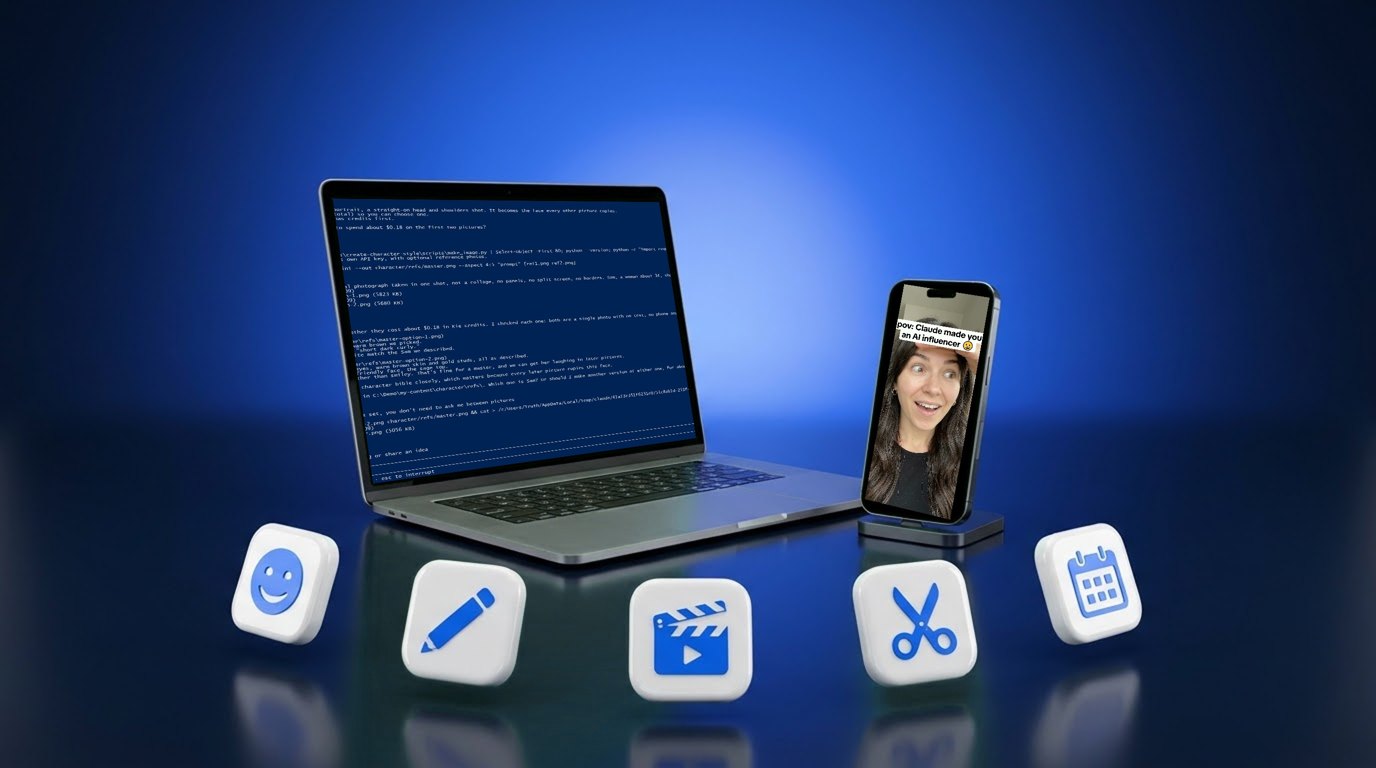
Want an AI creator of your own?
It's the step-by-step kit I'm built with. Claude Code builds your character and your look, writes your reels, makes the clips, edits them, and plans your posts. You don't have to be on camera.
See how it works →